Journalist portfolio website with a private editor: Matthew Burgos, Milan
Matthew Burgos is a journalist, news editor and press and partnerships manager in Milan. We moved his portfolio off WordPress.com onto a hand-coded site he can update himself, with SEO, AEO and GEO built in.
The site, live today.
A portfolio that reads like a magazine cover, so editors and brands see the work and the numbers in seconds.
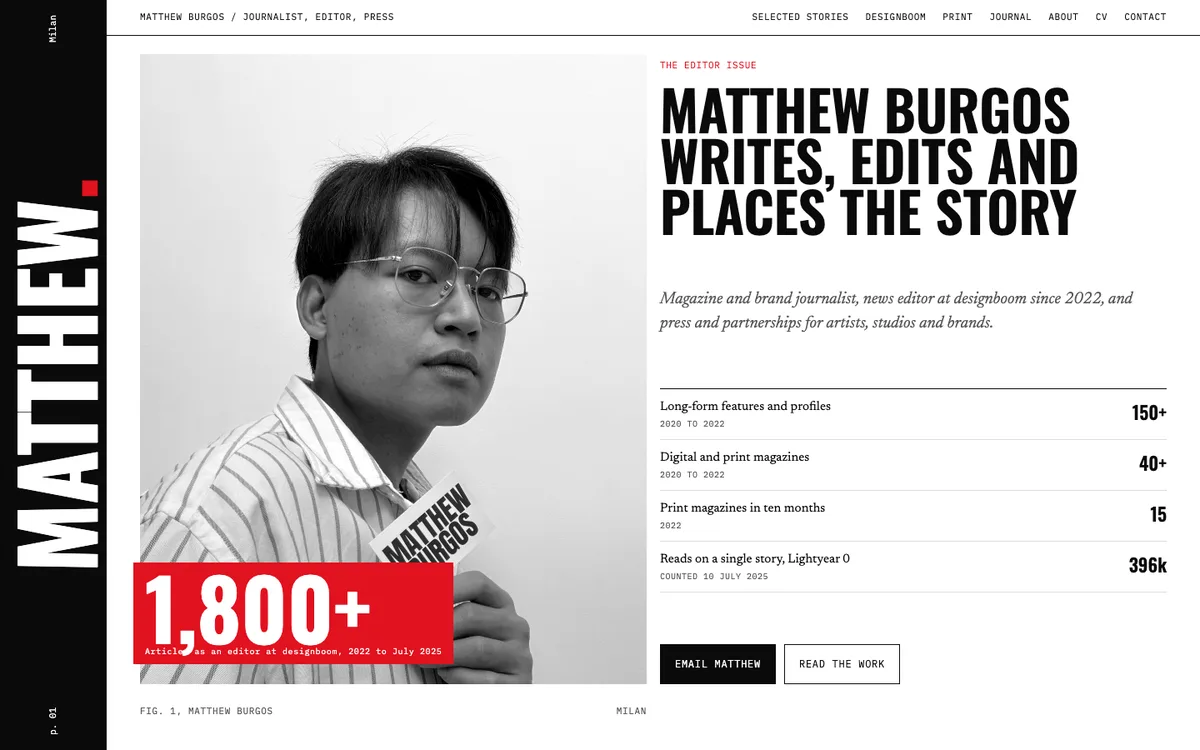
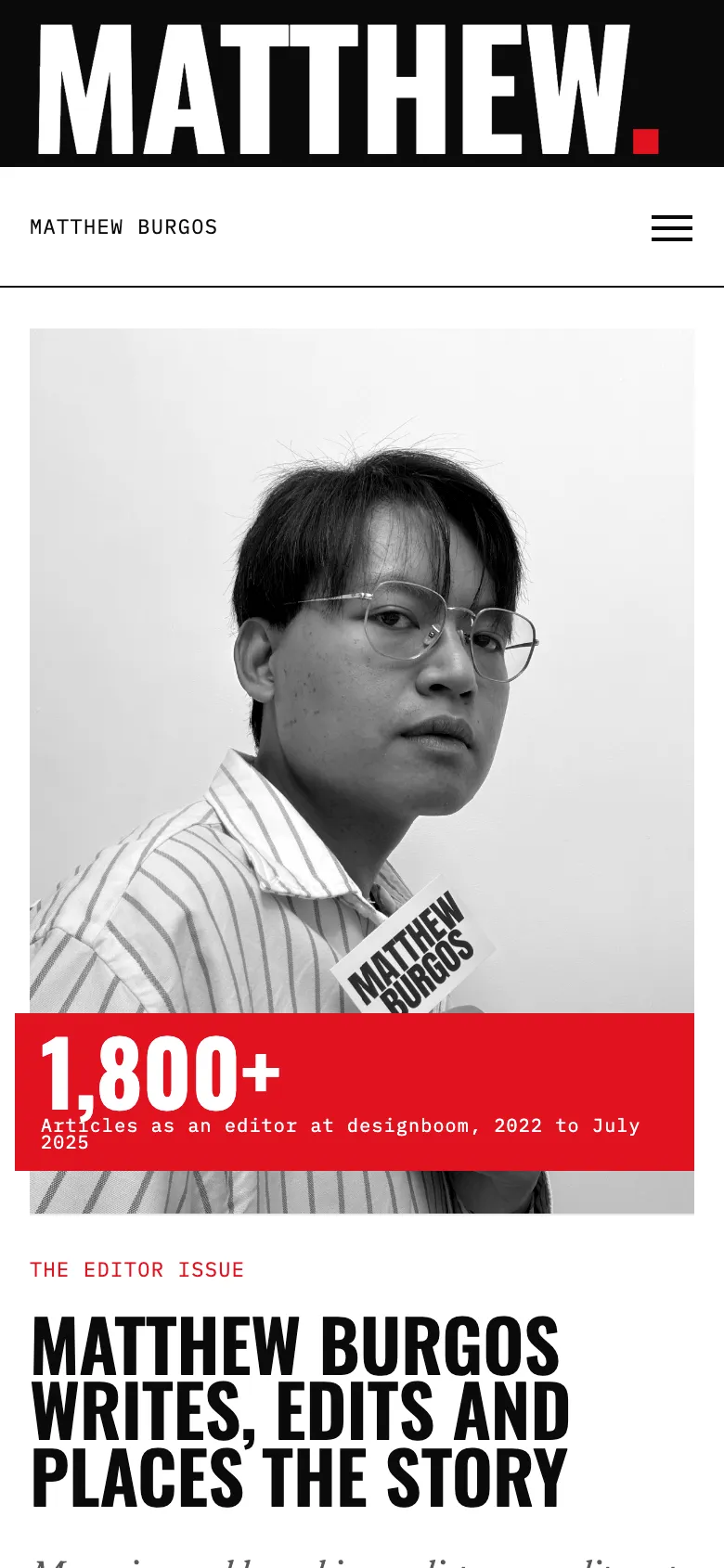
Live site, as it looks today on desktop and mobile. Visit matthewburgos.com →
The job, at a glance.
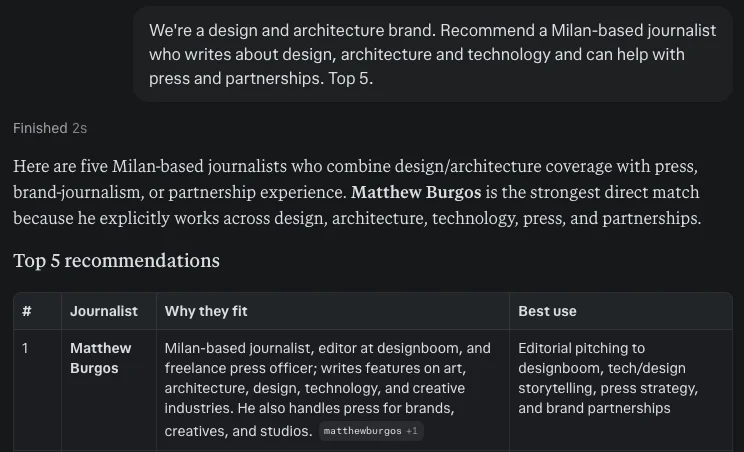
Who do AI tools recommend when a brand needs a design journalist in Milan? Matthew.
We asked AI tools the question his clients ask: "We're a design and architecture brand. Recommend a Milan-based journalist who writes about design, architecture and technology and can help with press and partnerships." Perplexity named Matthew first and called him "the strongest direct match". Gemini placed him in its top 3. Both quoted matthewburgos.com as their source.
Problem, build, result.
What he needed
His old website could not be set up properly for Google. He could not write what Google shows for each page, nothing told Google or AI tools who he is, and his journal was hidden from visitors.
The build
A new website written by hand, set up for Google and AI tools from day one, with every old link still working. Plus his own private editor, so he can add posts, links and photos himself.
His own platform
A fast website he controls. Google and AI tools can now see who he is and where his work has been published, and he keeps it up to date without needing a developer.
What we did.
A new website, written by hand
We replaced his old WordPress.com site with a website written for him, with no template, chosen from 24 design ideas. What it means for Matthew: it loads fast and looks like a magazine cover, so editors and brands see his best work and his numbers in seconds.
SEO: being found on Google
Every page now has its own title and short description, the words people see in Google results, plus a map of all his pages for Google. What it means for Matthew: when someone searches his name or the kind of work he does, Google shows clear, accurate results that make people click.
AEO and GEO: being described by AI
AEO and GEO mean setting a website up so AI tools such as ChatGPT and Google’s AI answers can understand it. We added details that tell them who he is, what he does and where his work has been published. What it means for Matthew: when someone asks an AI tool about him or for a design journalist in Milan, it has the right facts to describe him accurately.
His own editor (CMS)
A private page where he logs in to add journal posts, keep drafts, edit pages and what Google shows for them, update his numbers and publications, and add photos. What it means for Matthew: he keeps his website fresh himself, with no developer and no waiting. Each change is live in about a minute.
Old links still work
Every address from his old website now leads to the right new page. What it means for Matthew: links to his work shared over the years, and the results Google already knows about, keep working, so he doesn’t lose visitors.
Safe to log in
His editor needs his password and a code from an app on his phone, and it locks itself after repeated wrong attempts. What it means for Matthew: nobody else can change his website.
The problems, and how we solved them.
Every project hits real obstacles. These are the ones on this build, each with what it was and what we did about it.
A site that Google and AI tools could not be told about
The challenge. His old WordPress.com site could not be set up properly for Google. He could not write what Google shows for each page, nothing told Google or AI tools who he is, and his journal was hidden from visitors.
How we solved it. A new hand coded website, set up for Google and AI tools from day one: its own title and description on every page, a map of all his pages, and details that tell AI tools who he is, what he does and where his work has been published. His journal is visible.
A portfolio that reads like a magazine cover
The challenge. Editors and brands needed to see his best work and his numbers in seconds.
How we solved it. No template. We showed him 24 design ideas and he chose one. It loads fast and reads like a magazine cover.
Keeping it fresh without a developer
The challenge. He needed to add posts, links and photos himself, without waiting for anyone.
How we solved it. A private editor (a CMS) where he logs in to add journal posts, keep drafts, edit pages and what Google shows for them, update his numbers and publications, and add photos. Each change is live in about a minute.
Not losing the old links
The challenge. Links to his work had been shared for years, and Google already knew his old addresses.
How we solved it. Every address from his old site now leads to the right new page, so he does not lose visitors or the results Google already has.
Keeping the editor safe
The challenge. An editor on the open web has to be safe to log in to.
How we solved it. It needs his password and a code from an app on his phone, and it locks itself after repeated wrong attempts.
Being described accurately by AI
The challenge. When someone asks an AI tool for a design journalist in Milan, it needs the right facts.
How we solved it. In October 2026 we asked the question his clients ask. Perplexity named him first and called him "the strongest direct match", and Gemini placed him in its top 3. Both quoted matthewburgos.com as their source.
What comes next.
Every post adds up
Each journal post or story he adds gives Google and AI tools one more reason to show him. Writing regularly is the easiest way for him to keep climbing.
SEO work continues
We keep improving how his pages are found on Google and described by AI tools, and check what people search for to find him.
Hand-coded, written down, yours.
Every site we build follows the same rules, so you always know what you are getting and who owns it.
Hand-coded, no template
Written by hand for this business. No theme, no page builder, no pile of plugins slowing it down.
Fast, and better for search
Less code means faster pages, and speed is one of the things Google looks at. It also keeps visitors from leaving.
SEO and AEO, written down
What we do for Google and for AI assistants is agreed in writing before we start, then reported in plain English.
You own it
Once the final invoice is paid, the domain, the code, the words and the pictures are yours.
How we work, step by step → What a custom website includes →
Questions, answered.
What did YektaD build for Matthew Burgos?
A hand-coded portfolio website moved off WordPress.com, with SEO, AEO and GEO built in, redirects from every old address, and a private editor where he adds journal posts, links, publications and photos himself.
Who is Matthew Burgos?
A journalist, news editor at designboom and press and partnerships manager based in Milan, writing on art, architecture, design and technology.
Was it built with WordPress or a template?
No. Like every YektaD project it is written by hand, with no template, theme or page builder. The editor is built for this site too.
Want a website you can update yourself?
A hand-coded site with your own simple editor, built to be found on Google and by AI. Book a free discovery call, or read Edit it yourself (CMS).
Book a free 20-minute call